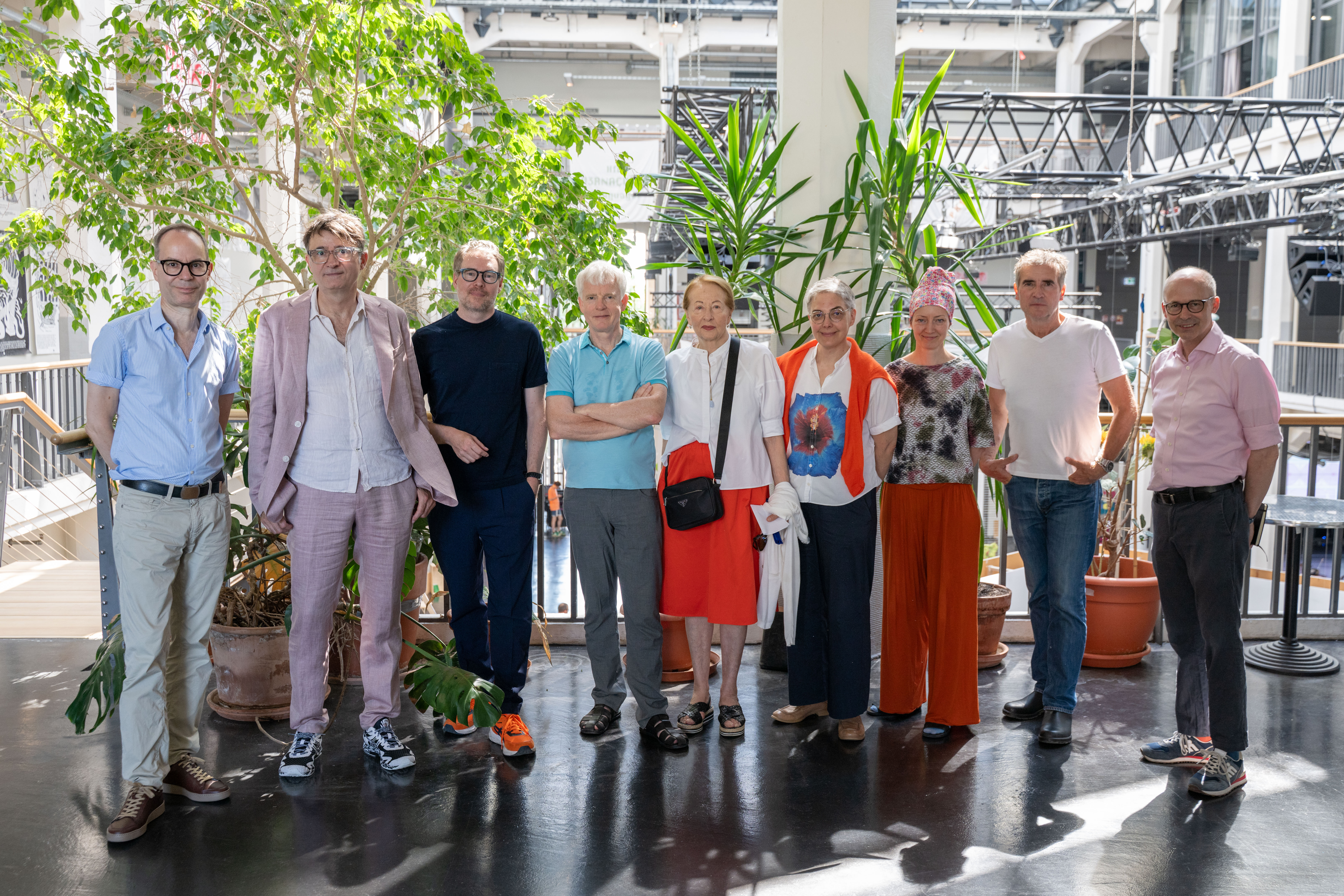
Award ceremony of the Fördergesellschaft ZKM / HfG

Award winners of the Karlsruhe University of Arts and Design (HfG) 2026

© Karlsruhe University of Arts and Design (HfG), photo: Julian Lindner

Since 1998, the Fördergesellschaft has been supporting students of the Karlsruhe University of Arts and Design (HfG) with an annual award ceremony for outstanding semester, master's or diploma theses in the subjects of product design, media art, photography, scenography and communication design, as well as art science with attractive prizes financed by the Fördergesellschaft and numerous supporters, such as the Schroff Foundations, the Heinrich Hertz Society, the  City of Karlsruhe, and private donors. In addition to recognizing their achievements, they enable the students to continue their projects and initiate new ones. 

In 2026, the jury of the Fördergesellschaft awards prizes with a total value of €8,000 on behalf of the Fördergesellschaft. Students are also supported by the Schroff Foundations with €5,000 and the City of Karlsruhe with €1,000. In addition, a prize of the Heinrich Hertz Society of €2,500 will be awarded as part of the students' exhibition.

Award categories & award winners 2026

  1. Anna Manankina: The Arbiter

    Award of the Fördergesellschaft

    3000 euros

    The Arbiter (project)

    In her project, HfG student Anna Manankina examines how the male gaze is reproduced through AI software, how censorship and sexualization coexist within these systems, and how the notion of "The Great Artist" persists in both historical and contemporary contexts.

    While researching the historical painting collection at Kunsthalle Mannheim, Manankina focused on Anselm Feuerbach's Hafis vor der Schenke (1852), which depicts the Persian poet Hafez reciting his poetry beside two silent, motionless women. Their stillness raises a question: what voices might these women reveal if freed from enforced spectatorship?

    The resulting work is a two-channel video installation based on the painting, animated through AI video generation and combined with live audio narration to imagine women's subjective experiences. Theoretically, the project draws on Valerie Solanas' 1967 S.C.U.M. Manifesto, a text of raw anger that became a formative force within radical feminism.

    During production, Manankina encountered the guardrails and censorship built into generative AI tools, prompting a central question: can mainstream Gen-AI still distinguish a historical painting from sexually explicit content? In practice, it often cannot — when fed a painting with even a subtle hint of nudity, AI video generators tend to render it in a realistically sexualized way, then flag their own output as "harmful content" and block it.

    For Manankina, this reveals an algorithm that is not just inconsistent but shaped by a dystopian, patriarchal logic — echoing 19th-century male artists who elevated the female nude as "Great Art" while strictly confining the roles women were allowed to play within it. The project concludes that these "Frameworks of Fiction" still govern the everyday tools we use, quietly deciding what cultural production is permitted — and what must be cut.

  2. Alejandra Miranda Janus: Layered Vision

    Award of the Fördergesellschaft

    3000 euros

    Layered Vision (project)

    The work was created in the seminar Frameworks of Fiction in collaboration with the Kunsthalle Mannheim. The seminar's starting point was a critical examination of the Kunsthalle Mannheim's collection, particularly its historical paintings and the image constructions they represent. Students were free to choose a work from the collection as the starting point for their own artistic work. Among the works addressed were The Execution of Emperor Maximilian, The Turkish Abduction of Women and Anselm Feuerbach's Hafiz at the Tavern, which forms the starting point of this work.

    Taking Feuerbach's Hafiz at the Tavern as its point of departure, the work deconstructs the painting's colonial image politics and hierarchical constructions. Figures who remain faceless in the original or appear merely as staffage are given individuality, a face and agency. Their new arrangement creates relationships marked by empathy, tenderness and mutual care. The central position of the Persian poet Hafiz is dissolved in favor of a collective structure.
    At the same time the work pushes back against the idea of the artist as an exceptional individual genius creating in isolation from their community. Against this idea it sets an understanding of artistic practice that grounds creative action in community, mutual listening, care and collaboration. Artistic creation appears not as an isolated act but as the result of social relationships and collective processes.

    The spatial installation consists of eight freely hanging linen cloths worked with various sewing machine stitches. Several image fragments extract the figures from Feuerbach's original composition and place them in new spatial relationships to one another. The hierarchical pictorial order of the original gives way to an open web of bodies, gazes and encounters.

    The materiality of the installation deliberately contrasts with the tradition of painting. In place of canvas stretched tightly over a rectangular frame are freely hanging lengths of fabric whose mobility gives them a sculptural quality. The seam replaces the brushstroke. While the preliminary sketch was traditionally seen merely as a preparatory step in painting, here the line itself becomes an image making element. As a connecting trace between the figures it makes relationships visible and takes the place of the painterly gesture.

  3. Mia Ferrari: no wind, no word

    Award of the Fördergesellschaft

    2000 euros

    no wind, no word (Diploma)

    Performance & Choreography: Sade Mamedova
    Sound Design: Lucia Böhm

    no wind no word is a twelve-minute multichannel video and sound installation. The work explores the interrelationships between body, space, sound, and image. These elements are not understood as separate media, but rather as a shared system in which they influence one another. Intuition serves as the artistic method here.

    The installation was created in collaboration with dancer and choreographer Sade Mamedova. Instead of a predetermined choreography, a clearly defined spatial and technical framework serves as the starting point. Multiple cameras, microphones, and a geophone record the same situation. The technology serves not only for documentation but becomes an integral part of the work itself, shaping the perception of movement, sound, and space.

    The starting point for the installation is the roof of the Large Studio at the HfG Karlsruhe. Although it is located in the center of the building, it appears deserted and is normally inaccessible. The architecture and atmosphere of the location influence the performance and make it possible to experience how strongly spatial conditions shape perception and action.

    The sound consists exclusively of recordings from the performance: breathing, footsteps, friction, resonances from the roof structure, and ambient noise. Music and speech are deliberately omitted. Breathing serves as the work’s metronome, linking movement, sound, and film editing. Three synchronized projections show the same moment from different perspectives. It is only through the interplay of image, sound, and the visitors’ movements that the installation comes into perception. There is no fixed vantage point and no unambiguous view of the action.

    The performance develops exclusively from the interplay of body, space, and sound. It does not tell a linear story, but rather makes states of being tangible and opens up associations with memory, projection, and inner dialogues, without definitively defining them.

    no wind no word explores how the body, technology, and architecture collectively generate perception. The installation invites viewers to embrace ambiguity and experience perception as an open-ended process. At the same time, it serves as the starting point for further artistic research in which the interplay of body, space, sound, and technology is developed in new spatial and performative contexts.

  4. Laura Waterstradt: Rote Saat

    Gunther Schroff Award

    5000 euros

    Rote Saat (Intermediate Diploma)

    “Rote Saat” (engl: "red seed") is an installation that explores the disappearance of traditional crop varieties in Germany and the importance of seed banks as living archives. The starting point is the observation of a drastic decline in crop diversity since the 20th century, caused by industrial agriculture, legal regulations, and the focus on a few high-yield varieties. Many regionally adapted heirloom varieties no longer meet today’s certification criteria and have consequently disappeared from cultivation.
    The work uses this development as an opportunity to make the processes of preserving, passing on, and reactivating seeds visible and tangible.

    The work was created in the context of artistic research into agroecological practices, seed policy, and collective forms of knowledge transfer. The starting point was a collaboration with local initiatives in Karlsruhe, in particular the community-supported agriculture project KArotte, the Social Garden (afka), and the Gene Bank for Wild Plants for Food and Agriculture.

  5. Lena Breitmoser: The Violent Container

    Award of the Heinrich Hertz Society

    2500 euros

    The Violent Container (Diploma)

    "The Violent Container" focuses on the cultural phenomenon of the cage, and caging as a practice to contain, categorise, restrict, and appropriate objects or bodies – as well as a tool to collect, treasure, preserve, and protect them.
    The project comprises an exhibition and a publication that examine the various properties and functions of the cage’s shifting forms, exploring how cages not only enable the administration of living or dead bodies and objects, but also govern the ways in which we perceive them.

    An enclosure, a prison cell, a menagerie, a vitrine, a collection, an exhibition, a cricket cage, a label. The publication gathers fragments of relevant texts, material examples and terms around the subject of the cage and caging as a cultural practice. While offering an analysis of different properties, mechanisms and protagonists surrounding the cage, it is a subjective collection, which is self-consciously incomplete. Like the textual translation of a patchwork blanket, it connects bits and pieces of pre-existing and newly commissioned materials and is the result of a polyphonic authorship.
    During the course of the diploma exhibition, the handbook was used as a body of reference on how to navigate the space and interpret its exhibits by linking them to specific pages or chapters within the collection. Printed matter and space, the research and artistic interpretations, were closely intertwined.

    The exhibition raised questions of accessibility, of hierarchies within the mediated encounter around a cage, of the limiting and violent act of categorising and being fitted into a pre-installed container, and of the purposefulness of a cage once it is stripped of its contents – of its failings and deficiencies. The display featured a voyeuristic window, photographic glitches, a reading station, a specimen table and a mechanical spectator.

    The site was an abandoned production hall for scientific and medical equipment, its empty structures oddly specific, yet generic at the same time. This genericity of the caging structures allowed for activation by the inserted exhibits: as a fictional layer of a possible past and usages was spun, connections were drawn to other places, similar caging structures, and their corresponding institutions.

  6. Christian Platz: Multiplied Objects as a Form of Self-Organization

    City of Karlsruhe University Award

    1000 euros

    Multiplied Objects as a Form of Self-Organization (Master’s thesis)

    Art publications and multiples from the 1960s share structural and conceptual parallels that can be understood in this work as expressions of self-organized artistic practice.

    Based on a critical examination of the established art system, alternative formats of production and distribution emerged during this period that were based on reproduction, participation, and autonomy. Using exemplary case studies, including the intermedia publication objects "dokumentation b", "Edition Et", the magazines "spirale" and "rot", the multiples of Edition "MAT", and the serial objects of "Gruppe X", this work shows how the corresponding forms of work can be positioned as curatorial, serial, and participatory media.

    The work contextualizes these formats both in terms of media aesthetics and cultural politics and understands them as material strategies of self-organization. It argues that art publications and multiples not only functioned as expressions of an alternative public sphere, but also served to develop early models of a decentralized artistic infrastructure. This perspective enables a genealogical reassessment of the multiple by breaking away from the established discourse framework centered on Marcel Duchamp and opening up a broader perspective.

Jury members

The jury consisted of Dr. Marlene Angermeyer-Deubner (ZKM/HfG Support Association), Dr. Sebastian Baden (Schirn Kunsthalle Frankfurt), Dr. Anett Holzheid (ZKM), Prof. Dr. Inge Hinterwaldner (Free University of Bolzano), Prof. Mischa Kuball (Academy of Media Arts Cologne), and Dr. Henning Rickmann (ZKM/HfG Support Association).

A group photo of the jury members is shown.
© Karlsruhe University of Arts and Design (HfG), photo: Eisenhart Keimeyer

Footer

ZKM | Center for Art and Media

Lorenzstraße 19
76135 Karlsruhe

+49 (0) 721 - 8100 - 1200
info@zkm.de

Organization