
Paul Ryan: Self-Processing
Radical Software Vol. 1, Nr. 2 (1970)
_______________________________________________________________________________________
_______________________________________________________________________________________
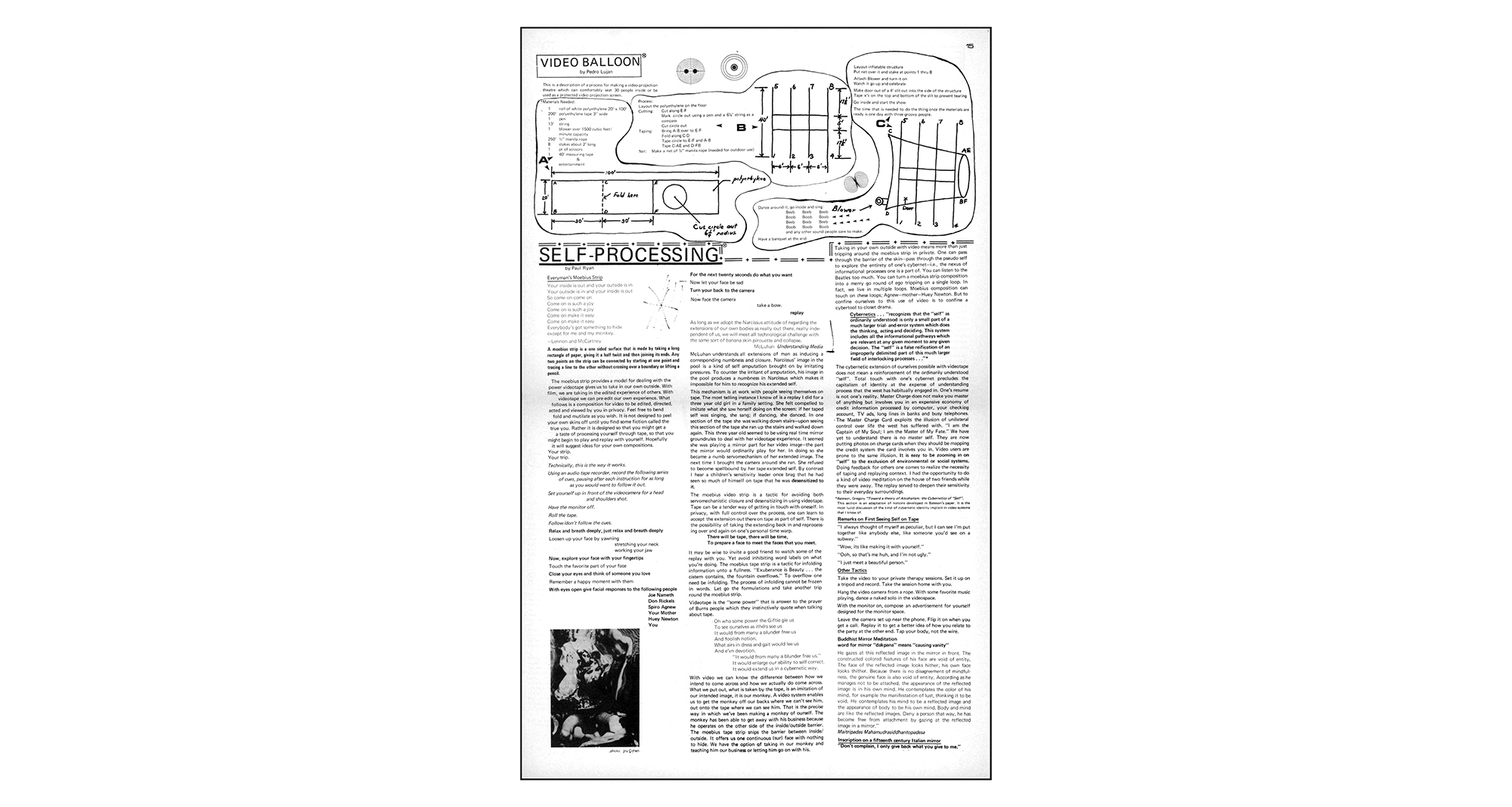
As long as we adopt the Narcissus attitude of regarding the extensions of our own bodies as really out there and really independent of us, we will meet all technological challenges with the same sort of banana-skin pirouette and collapse.
––– Marshall McLuhan, »Understanding Media«, 1964
McLuhan understands all extensions of the human being as something that induces a corresponding numbness and closure. Narcissus’s reflection in the pond is a kind of self-amputation caused by unsettling tensions. To counteract the stimulus of the amputation, his reflection in the pond induces a numbness in Narcissus that makes it impossible for him to recognize his own extended self.
This mechanism is at work when people see themselves on video. The most revealing example I know of is the playback of a video I had filmed of a three-year-old girl in her family environment. She felt compelled to imitate what she saw herself doing on the screen. When her self on video sang, she sang too; when it danced, she danced too. At one point in the videotape, she was walking down a flight of stairs—as soon as she saw that clip, she ran up the stairs and walked back down. This three-year-old seemed to be using basic mirroring principles in real time to cope with her videotape experience. Apparently, she was playing the part of the mirror image for her videotape self—that is, the part that the mirror usually plays for her. In doing so, she became a numbed servomechanism of her extended image. The next time I brought my camera, she ran away. She refused to be enchanted by her self as extended by the videotape. In contrast, I once heard a leading proponent of childlike sensitivity boast that he had seen so much of himself on videotape that he had become desensitized to it.
The Möbius videotape is a tactic that allows one to avoid both the servomechanical closure and the desensitization associated with the use of videotape. Video can be a gentle way to connect with oneself. In the private sphere, with complete control over the process, one can accept the extension out there on the videotape as part of oneself. There is the possibility of taking the extension back and reworking one’s own personal time loop over and over again.
There will be videotape, there will be time. To prepare a face to meet the faces that you meet.
_______________________________________________________________________________________
Editors: Beryl Phyllis, Korot Gershuny
Editorial Consultant: Michael Shamberg
Publisher: Ira Schneider
Production: Phyllis Gershuny, Beryl Korot