
- Event
- Conference
Envisioning AI: Legacy and Impact of the Connection Machine
Conference
Fri, March 27 – Sat, March 28, 2026
Why do certain technologies fall into oblivion—and what can we learn from them today?
How did the Connection Machine combine computation, design, and ideas of intelligence?
And what does its example reveal about today’s largely opaque AI systems?
The Connection Machine (CM) was the first commercial supercomputer with a massively parallel architecture – a technological pioneering achievement that contributed significantly to the development of modern high-performance computers (HPC) and AI systems. Developed in the years between 1983 and 1994 by Thinking Machines Corporation (TMC), the Connection Machines – featuring the models CM-1, CM-2, and CM-5 – were inspired by the question of how intelligence emerges in the human brain through complex, networked, and parallel processing.
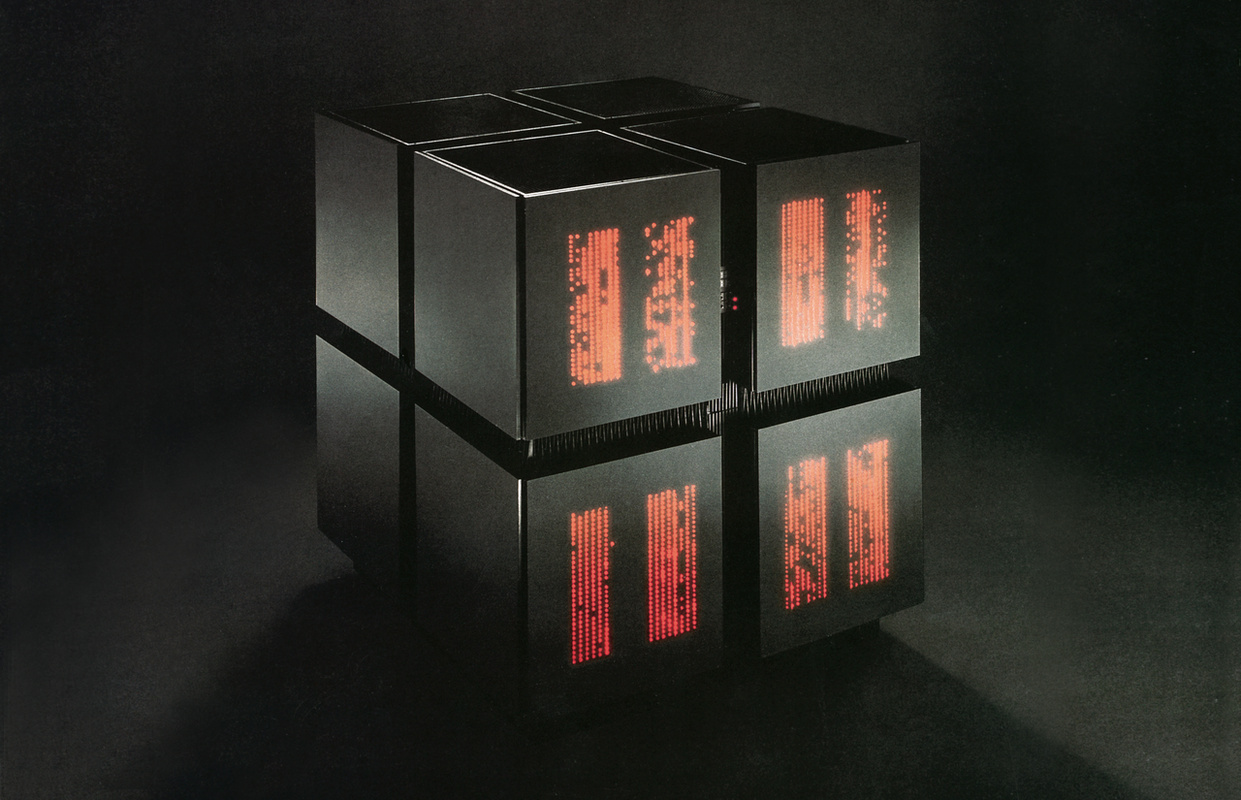
Beyond its technical innovations, the CM was distinguished by a design philosophy that treated visualization as an integral part of computation. It translated abstract principles such as massive parallelism into a spatial, “electronic brain”–like form that made internal processes perceptible. At a time when contemporary AI systems—especially large-scale language models—largely remain visually opaque, the CM continues to serve as a reference for the epistemic role of design in mediating between technical complexity and broader comprehension.
The diverse expertise that came together in the CM series found its way into the work of influential technology companies through various paths following the company’s bankruptcy. For instance, parts of TMC were acquired directly by Sun Microsystems in 1994 (which was itself later acquired by Oracle in 2010). In addition, several innovative startups founded by former TMC employees were taken over by big digital corporations – such as Alexa Internet by Amazon or Metaweb by Google. Despite its far-reaching technological influence, CM’s formative role in the history of AI and high-performance computing remained largely unrecognized after TMC filed for bankruptcy in 1994. The aim of the upcoming conference is therefore to foreground CM’s previously unknown legacy: as a visionary technology that shaped the development of today’s AI and supercomputing landscape. This will be accomplished through three thematic sections exploring the following aspects of CM: its technological complexity, the aesthetics of its design, and the AI landscape as of today. At the same time, the conference aims to analyze why the achievements of this supercomputer – so far ahead of its time – have faded into obscurity.
In parallel to the conference, a historical CM-2 will be on display in the ZKM foyer.
Envisioning AI: Legacy and Impact of the Connection Machine
Sessions
-
Day 1, Session 1:
Friday, March 27
Technical Legacy and Impact of the Connection Machine
Location: ZKM Media Theater & Live Streaming
Moderated by: Michael Beigl, Hanna Jurisch, Daria Mille, Tamiko ThielDay One of the conference offers a profound exploration of the technological foundations and enduring influence of the Connection Machine (CM).
The conference program foregrounds the CM’s technical complexity and systemic impact by examining how its architecture anticipated key concepts in today’s computing environments. The program offers a unique opportunity to reconsider the material foundations of AI technologies and to reflect on how early visions of intelligent machinery continue to shape today’s technological landscape.
14:00 CET Welcome and Introduction Alistair Hudson (Artistic & Scientific Director, ZKM | Karlsruhe), Michael Beigl (Professor, Pervasive Computing Systems, KIT), Tamiko Thiel (Artist and Co-designer of CM-1 and CM-2) 14:15 CET
digitalIntroduction and Greetings
W. Daniel Hillis (Inventor and Co-founder of Thinking Machines Corporation)14:30 CET
digitalKeynote Lecture and Q&A
Thomas Haigh (Professor and Chair, History Department, University of Wisconsin-Milwaukee)
Why Did They Say the Machines Were Thinking?15:10 CET
digitalGreetings
MIT Museum Cambridge, Massachusetts15:15 CET Lightning Talks Brewster Kahle (Digital Librarian of the Internet Archive), Lew Tucker (Computer Scientist and Technology Executive), Joseph Bates (Computer Scientist and Head of Billion Core PBC) (digital) 16:00–16:30 CET Coffee Break 16:00 CET
livestream onlyScreening
Essay film by Max Clausen
Thinking Machines Corporation16:30 CET Lecture
Heiner Igel (Professor of Seismology, LMU Munich)
The Joy of Programming the CM: 3D Waves in a Complex Earth
Performance Clapping Music
by Steve Reich. Performed by Thibault Keith, Xinlu Wei, Finn Kiefl, Tolga Anlar, Minoru Saito, Shawn Hsiao (University of Music Karlsruhe, class of Prof. Vanessa Porter)17:00 CET Lecture and Q&A
Thomas Lippert (Director, Jülich Supercomputing Centre (JSC), Forschungszentrum Jülich)
From Connection Machine to Exascale: Reflections on Parallel Computing17:45 CET
digitalLecture and Q&A
Johannes Schemmel (Professor of Neuromorphic Computing Architectures, Heidelberg University)
Learning from the Brain: Neuromorphic Computing and the Future of AI18:30 CET Break 18:45 CET Panel Discussion, moderated by Michael Beigl and Tamiko Thiel
With: Heiner Igel, Brewster Kahle, Thomas Lippert, Klaus Schilling, Lew Tucker19:45–20:00 CET Closing Remarks -
Day 2, Session 2:
Saturday, March 28
Computational Aesthetics: Design and Creative Practice on the Connection Machine
Location: ZKM Media Theater & Live Streaming
Moderated by: Margit Rosen (Head of the Department of Collection, Archives and Research, ZKM | Karlsruhe)Integrating computation with a bold philosophy of visualization, the CM translated abstract principles such as massive parallelism into tangible form — a spatially expressive “electronic brain” that made complex internal processes perceptible. The CM-2 stands out as an object whose external form was deliberately conceived to render a highly complex architecture visually and spatially intelligible. It also serves as a valuable reference point for understanding how design mediates between algorithmic complexity and broader comprehension. At the same time, artists such as Karl Sims used the CM’s parallel processing power to create pioneering simulations and evolutionary animations, showing how advanced computational research could also become a medium for experimental visual art.
11:00 CET Welcome and Introduction
Alistair Hudson (Artistic & Scientific Director, ZKM | Karlsruhe)11:05 CET Impulse Lecture
Tamiko Thiel (Artist and Co-designer of CM-1 and CM-2) & Gordon Bruce (Design Consultant, former Thinking Machines Corporation)
Designing the Connection Machine: Let the Machine Speak for Itself11:30 CET Impulse Lecture
Natalie D Kane (Curator of Digital Design, V&A, London)
Is This Thing On? Imagination, Computation and Speculation with the CM-211:45 CET Impulse Lecture
Paul Galloway (Senior Collection Specialist for the Architecture & Design Department, MoMA, New York)
Art in our Time: The Connection Machine at MoMA12:00 CET Panel Discussion, moderated by Margit Rosen
Michael Beigl, Gordon Bruce, Paul Galloway, Natalie Kane, Tamiko Thiel12:30 CET Screening of computer animations by Karl Sims, with introduction by Margit Rosen.
Particle Dreams (1988)
Panspermia (1990)
Primordial Dance (1991)
Liquid Selves (1992)
Evolved Virtual Creatures (1994)12:45 CET
digitalImpulse Lecture
Gary Oberbrunner (Software Engineer and Technology Executive)
From Connection Machine to Creative Machines13:00–14:00 CET Lunch Break -
Day 2, Session 3:
Saturday, March 28
From Thinking Machines to Today’s AI Landscape
Location: ZKM Media Theater & Live Streaming
Moderated by: Alistair Hudson, Daria MilleThis session turns to the present, examining today’s AI landscape through the historical lens of the Connection Machine and its early visions of distributed intelligence. While massively parallel architectures once embodied technological optimism about “thinking machines,” contemporary AI systems — from large language models to data-driven infrastructures — raise urgent questions about power, bias, and responsibility. Bringing together artists and theorists, this section approaches AI from critical and intersectional perspectives. What kinds of knowledge, labor, and data underpin today’s large-scale AI systems? Whose voices remain invisible or are deliberately silenced? In what ways do current AI systems reproduce colonial logics? And how might artistic practices help to expose, challenge, and reimagine the socio-technical systems behind AI?
14:00 CET Welcome and Introduction
Daria Mille (Curator, ZKM | Karlsruhe)14:10 CET Keynote Lecture and Q&A
Sarah Ciston (Professor of Computational Thinking and Aesthetic Doing, Academy of Media Arts, Cologne)
Don’t (?) Be Evil: Reckoning with the Risks of Technofascism from ELIZA to Anthropic (or: How I learned to worry just enough to keep loving what I code)15:00 CET
digitalGreetings
MIT Museum Cambridge, Massachusetts15:05 CET Lecture and Q&A
Tiara Roxanne (Researcher and artist)
Automated Extraction at the Borderlands15:50 CET Lecture and Q&A
Cecilie Waagner Falkenstrøm (Artist)
Artistic Practice in the Age of LLMs: From 2016 to Today16:35 CET Coffee Break 17:10 CET Lecture Performance
Kim Albrecht (Professor of Information Design, Folkwang University of the Arts, Essen)
Artificial Worldviews17:40 CET
digitalLecture and Q&A
Nora N. Khan (Independent Critic and Curator)
Imagining Computation: Presence & Absence18:30–19:45 CET Wrap-up Discussion, moderated by Alistair Hudson
Kim Albrecht, Sarah Ciston, Cecilie Waagner Falkenstrøm, Nora N. Khan (digital), Tiara Roxanne
Livestream
In cooperation with


Supported by


Imprint
Conceived and developed by: Michael Beigl, Alistair Hudson, Daria Mille, Tamiko Thiel
Project Assistance: Hanna Jurisch
Supported by: Hosna Karnama, Sasha Meyer
Event: Viola Gaiser, Wolfgang Knapp, Henning Möller, Lucia Stockinger, Marcus Thiel
Video studio: Moritz Büchner, Max Clausen, Seline Herzog, Andy Koch, Christina Zartmann
Communication and marketing: Marlen Ernst, Angela Fritz, Sabine Jäger, Sebastian Klein, Franziska Klöck, Lilli Roser
Copy editing: Gloria Custance, Daria Mille
Graphic design: Sascha Fronczek
Special thanks to: Deborah Douglas, Michael John Gorman, Mira Hirtz, Clara Runge, Dominique Theise, Almut Werner, ZKM Shop and Information Desk