
H. Philip Peterson
Mona by the Numbers
1965
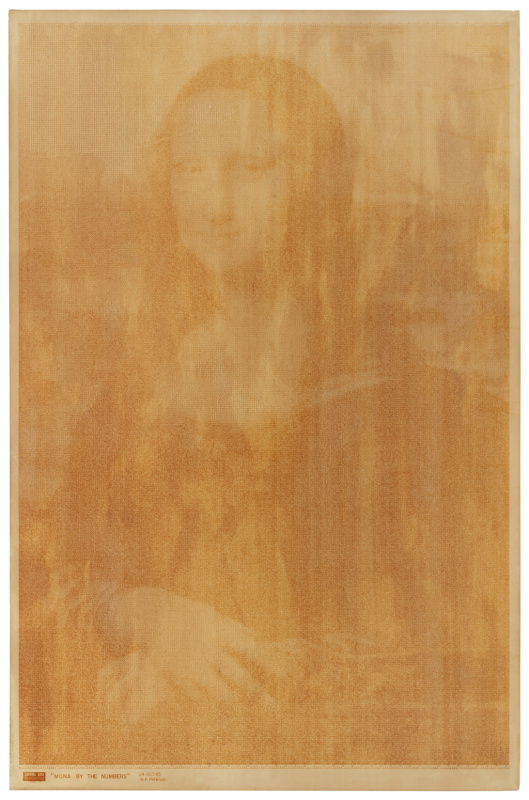
© H. Philip Peterson; photo © ZKM | Center for Art and Media Karlsruhe, photo: Franz J. Wamhof
- Artist / Artist group
- H. Philip Peterson
- Title
- Mona by the Numbers
- Year
- 1965
- Edition / Serial number
- unbekannt
- Copy Number
- unbekannt
- Category
- Computer-generated
- Format
- Plotter Drawing
- Material / Technique
- computer-generated graphic ; computer (scanning process): CDC 160, computer (image generation): CDC 320; output: incremental plotter; diazo print on paper and polyurethane rigid foam board
- Dimensions / Duration
- 119,5 x 78 x 0,6 cm
- Collection
- ZKM | Center for Art and Media Karlsruhe
- Description
- The portrait of the Mona Lisa dissolves into a field of digits when viewed up close: 256 columns, 390 rows, around 100,000 cells, each containing two digits. »Mona by the Numbers« is an early example of how a computer can break an image down into measurable values and use them to produce a visible image again. A CDC 160 computer controlled a high-resolution scanner that recorded a colour slide of the Mona Lisa point by point. A brightness value was determined for each area of the image. The plotter used for the output — a device that draws lines — could not reproduce these values directly as correspondingly light or dark areas on paper. Peterson therefore found a workaround: he translated the brightness values into two-digit numbers and even designed a special typeface for them. The higher the numerical value, the darker the cell appears to the eye. A related principle was used in 1965 by the Mariner 4 space probe: its first close-up images of Mars were likewise divided into individual image areas, with the brightness of each encoded as a numerical value and transmitted back to Earth. H. Philip Peterson worked at the Digigraphic Laboratories of the Control Data Corporation. »Mona by the Numbers« appeared on the cover of the December 1965 issue of »Computers and Automation«, which had held an annual computer art competition since 1963.
Author
Margit
Rosen
Images
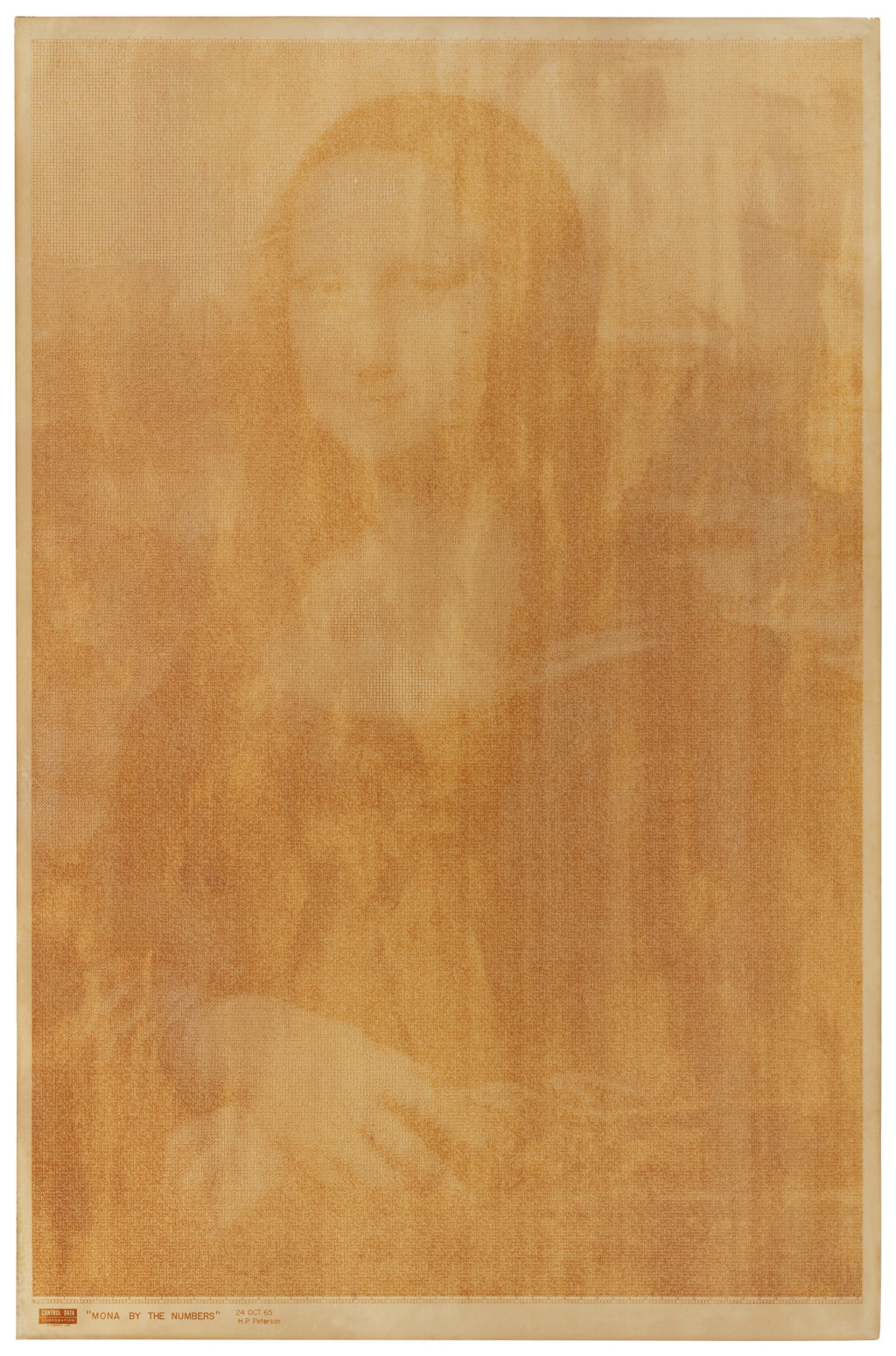 H. Philip Peterson, »Mona by the Numbers«, 1965, computer-generated graphic ; computer (scanning process): CDC 160, computer (image generation): CDC 320; output: incremental plotter; diazo print on paper and polyurethane rigid foam board, 119,5 x 78 x 0,6 cm, ZKM | Center for Art and Media Karlsruhe.© H. Philip Peterson; photo © ZKM | Center for Art and Media Karlsruhe, photo: Franz J. Wamhof