Symposium
Archival Intelligence: AI x Archives x Museums
Wed, December 10, 2025 10:00 am – 5:30 pm CET
Lecture Hall
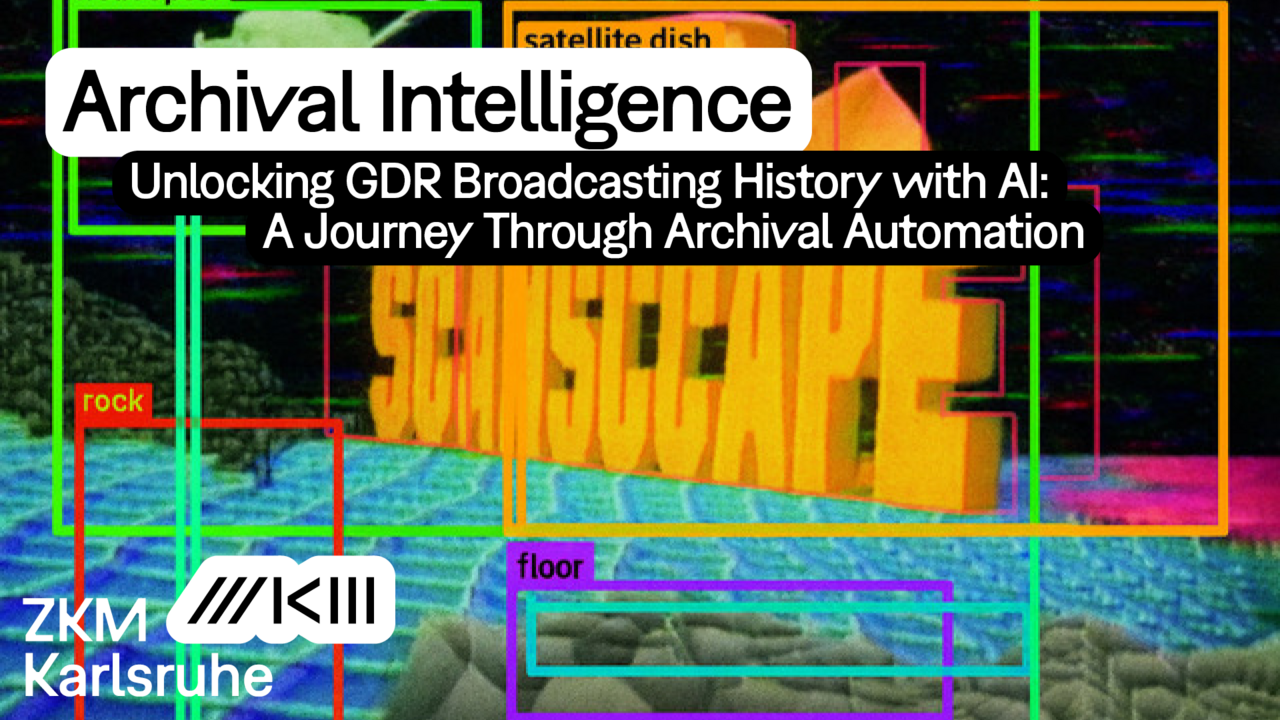
At the German Broadcasting Archive a dedicated Automation Team was established in 2022 with the goal to bring AI and automated workflows into archival processes. Since then, the team has experimented with Large Language Models and other AI tools for transcription and indexing. Based on these experiences, they set up projects to integrate the tools into daily documentation workflows. The team is currently finalizing a web application that enhances AI analysis of GDR broadcasting records and provides tools for validating outcomes before database integration. This presentation will detail the challenges encountered in applying AI to often fragile and complex historical recordings and the iterative development process that led to a specialized web application.
Archives and museums are placing great hopes in Artificial Intelligence. Time-consuming, labor-intensive tasks — such as the description and analysis of objects — can already be, or may soon be, taken over by machines. Artificial Intelligence (AI) promises not only access to previously unexplored holdings but also new, powerful analytical tools for research, enabling the extraction of new information about cultural objects and the visualization of previously unseen connections. Finally, the hope is that automation will free valuable resources for research and creative work with cultural heritage.
The conference »Archival Intelligence: AI × Archives × Museums« asks where we currently stand with regard to these promises. It seeks to show where and how AI can be used in practice and to open a discussion on the new possibilities and consequences arising from the availability of these technologies — implications that we may not yet have anticipated. The focus lies on concrete applications of AI — from automated text, speech, and handwriting recognition, and the analysis of images and videos, to the cataloguing of archival holdings and scholarly data analysis, the curation of collections, AI-supported provenance research, and restoration.
Experts from museums, archives, and universities offer practice-oriented insights into the use of AI as an analytical tool and as valuable support for semantic indexing and targeted information retrieval. Particular emphasis is placed on learning from applications outside the fields of art and culture, such as research data management, in order to develop pragmatic approaches for museums and cultural archives.
Organized by the ZKM | Center for Art and Media, one of the leading institutions in the field of media art and recognized for its expertise in the preservation of electronic and digital artworks, this conference offers an opportunity to discover innovative approaches and to engage with experts who are actively shaping the future of work with cultural and scholarly objects.
With
Dominik Bönisch Alpári (Düsseldorf University of Applied Sciences), Giovanni Colavizza (University of Copenhagen), Robert G. Erdmann (University of Amsterdam), Ralph Ewerth (TIB Hannover), Jasmijn Van Gorp (Utrecht University), Adelheid Heftberger (Federal Archives), Andreas Kohlbecker (ZKM | Karlsruhe), Bárbara Romero Ferrón (Leuphana University Lüneburg), Heiko Schuldt (University of Basel), Christiane Sibille (ETH, Zurich), and Kim Voss (DRA | German Broadcasting Archive).
The conference is part of the »Artificial Intelligence & Art« funding project of the City of Karlsruhe.
Imprint:
Margit Rosen: Concept
Idis Hartmann: Concept
Andreas Kohlbecker: Research Associate
Felix Mittelberger: Research Associate
Lorenzstraße 19
76135 Karlsruhe
+49 (0) 721 - 8100 - 1200
info@zkm.de