Michael Gleich, Jeffrey Shaw, Bernd Lintermann, Torsten Belschner, Lawrence Wallen, Manfred Wolff-Plottegg
Web of Life (Satelliten- oder Remote-Stationen)
2002
© Michael Gleich, Jeffrey Shaw; Photo © Photo: Frieder Blickle
- Artist / Artist group
- Michael Gleich, Jeffrey Shaw, Bernd Lintermann, Torsten Belschner, Lawrence Wallen, Manfred Wolff-Plottegg
- Title
- Web of Life (Satelliten- oder Remote-Stationen)
- Year
- 2002
- Category
- Installation
- Computer-based
- Material / Technique
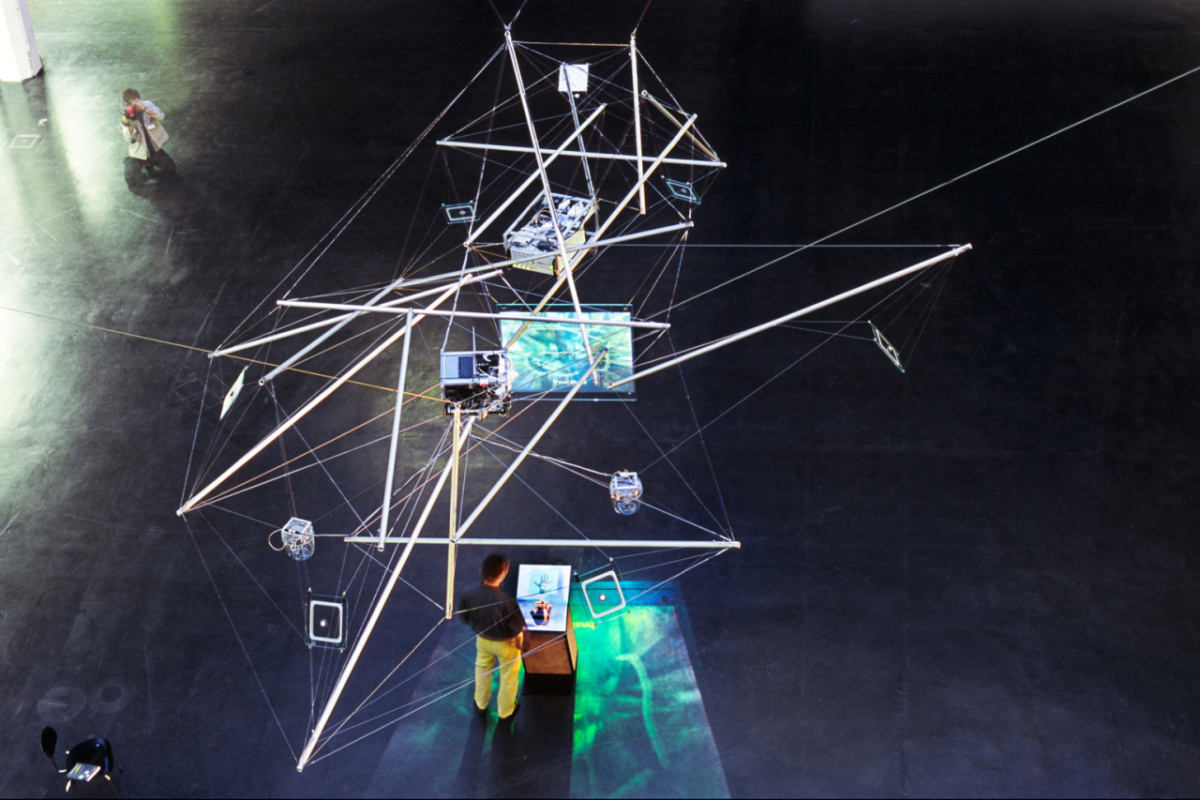
- Neon sign Floor station: hand scanner (video camera, computer (PC), operating system (Windows XP), custom software, Mini LED photo sensor), computer (PC), operating system (Linux), custom software, computer (Power Mac G4), operating system (OS9), custom software, demountable architectural element, holographic optical projection screen, subwoofer, six speakers (active), projector, deflection mirror Hanging construction (tensegrity): hand scanner (video camera, computer (PC), operating system (Windows XP), custom software, Mini LED photo sensors, pedestal), computer (PC), Linux operating system, custom software, computer (Powerbook), operating system (OS9), custom software, aluminum tube and wire structure, holographic optical projection screen, subwoofer, six speakers (active), projector, deflection mirror
- Dimensions / Duration
- 240 x 180 x 550 cm, installation dimensions variable
- Description
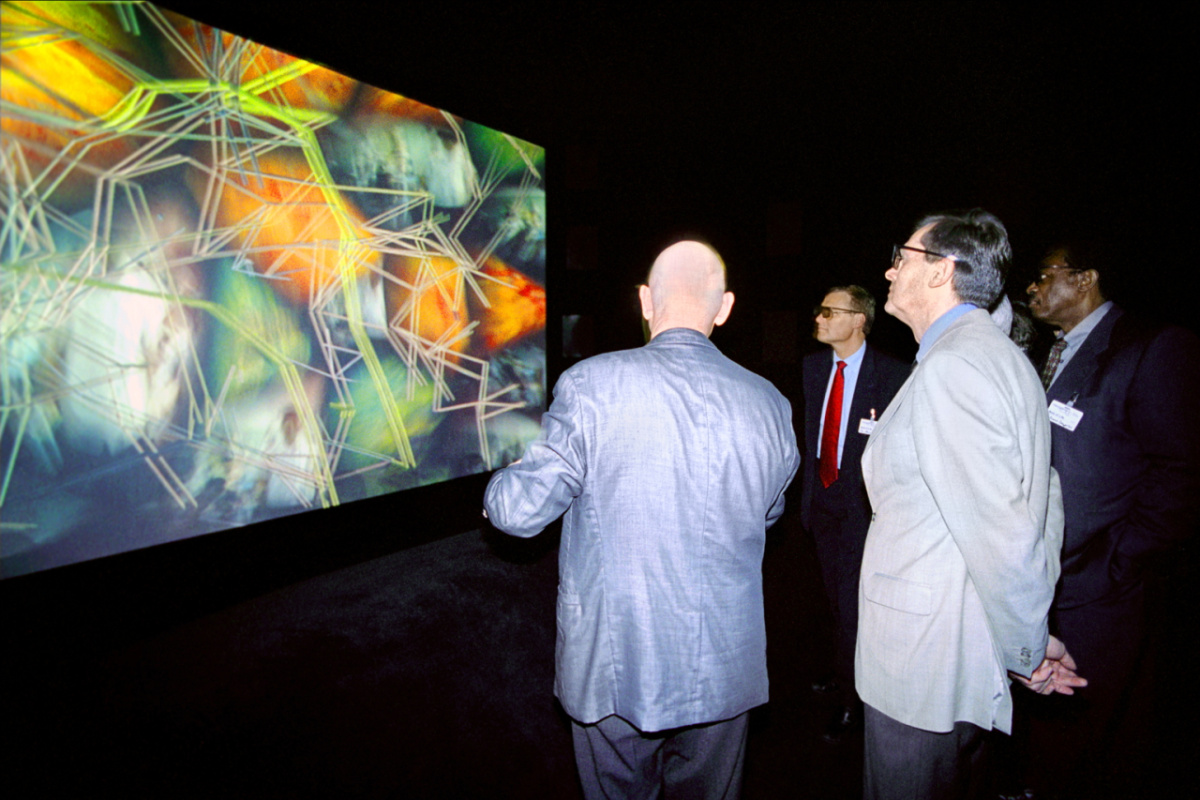
- A hand on a glass plate. The camera captures the palm lines, an algorithm traces them, and seconds later they appear on the large projection screen: merged with the palm lines of other visitors who have placed their hands on other glass plates in other parts of the world. From these lines emerges a constantly shifting fabric of images and sounds. »Web of Life« is a globally networked artwork. Alongside the permanent installation at ZKM Karlsruhe, four additional terminals travelled over two years to exhibitions and festivals in New York, Tokyo, Berlin, Melbourne, São Paulo, and other cities. All stations were connected: a hand scanned in São Paulo left traces visible in Karlsruhe – and vice versa. The visual world of the work revolves around the motif of the network. Real-time 3-D projections merge with archival footage showing various forms of interconnection: the street grid of a city, the traces on a circuit board, the branches of a river delta, the web of human arteries. The software organises these elements according to principles modelled on biological growth processes – neuronal branching, cellular structures. The palm lines of visitors intervene in this system, modulating both the visual composition and the soundscape. At ZKM, Manfred Wolff-Plottegg designed a dedicated space for the work: a cave-like, black architecture without right angles, in which stereoscopic projections appear on a 3.35 by 7 metre screen, accompanied by a 70.1-channel surround system. For the travelling terminals, he created a tensegrity structure of cables and tubes – itself a network. The work was created under the direction of Jeffrey Shaw together with Michael Gleich, Bernd Lintermann, Torsten Belschner, Lawrence Wallen, and Manfred Wolff-Plottegg. An accompanying book by Michael Gleich and a dedicated website were also published.
Author
MR
Images
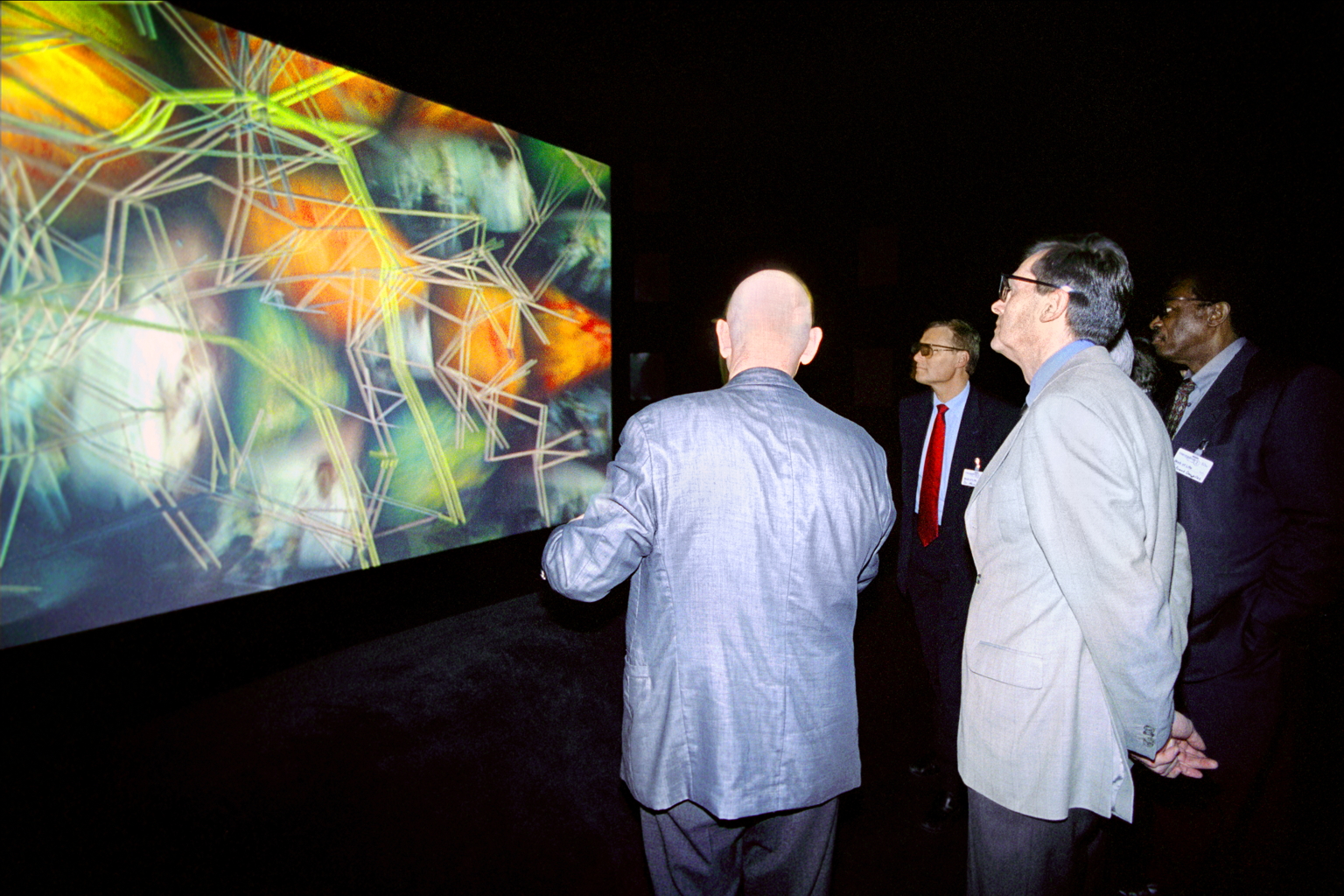 Michael Gleich, Jeffrey Shaw, »Web of Life«, 2002, computer-based interactive installation, 240 x 180 x 550 cm, installation dimensions variable, ZKM | Collection© Michael Gleich, Jeffrey Shaw; Photo © Photo: Frieder Blickle
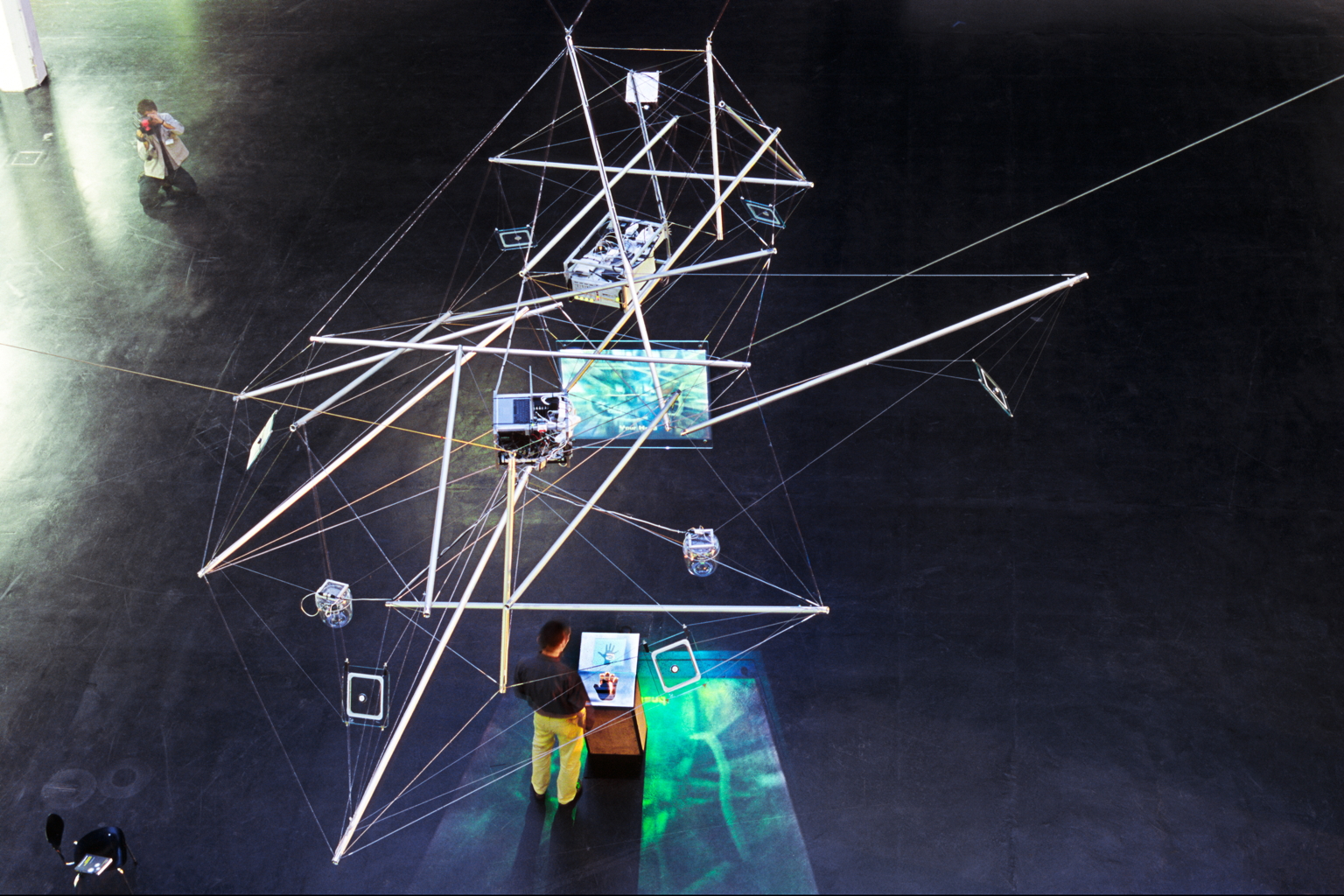 Michael Gleich, Jeffrey Shaw, »Web of Life«, 2002, computer-based interactive installation, 240 x 180 x 550 cm, installation dimensions variable, ZKM | Collection© Michael Gleich, Jeffrey Shaw; Photo © Photo: Frieder Blickle