
Neil Brown, Dennis Del Favero, Jeffrey Shaw, Peter Weibel
T_Visionarium II
2008
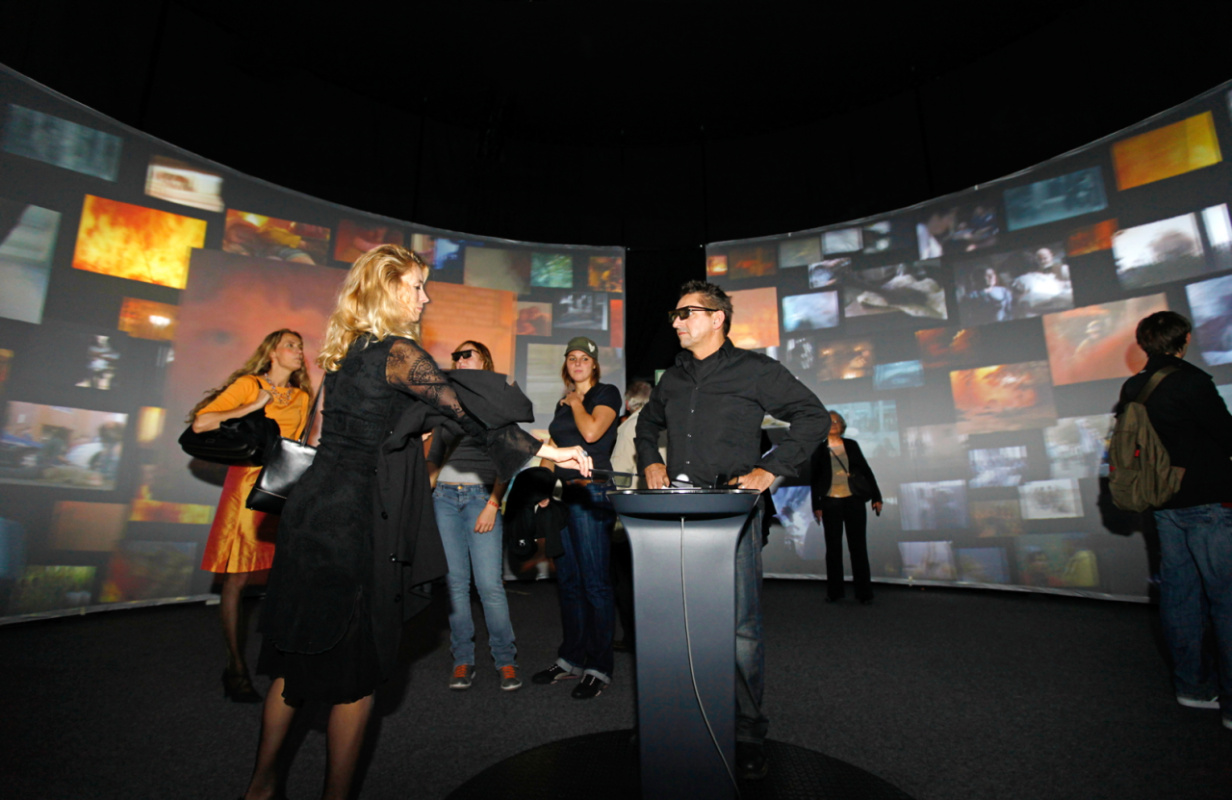
© Neil Brown, Dennis Del Favero, Jeffrey Shaw, Peter Weibel; Photo © ZKM | Center for Art and Media, Photo: ONUK
- Artist / Artist group
- Neil Brown, Dennis Del Favero, Jeffrey Shaw, Peter Weibel
- Title
- T_Visionarium II
- Year
- 2008
- Category
- Computer-based
- Video
- Installation
- Format
- Video Installation
- Material / Technique
- Purpose-built circular theater (steel tube, truss, molleton) with entrance behind light trap, seven computers (PC) (six graphics computers, one control computer), operating system (Windows XP), custom software (based on proprietary Virtools Game Engine, licence on IG0 computer), two TFT monitors, pedestal with interface, custom-made electronics (based on Intersense InertiaCube3 inertial tracker), audio interface (RME Fireface), network switch (KVM), network switch, six projector pairs with polarizers, stereo projection screen (perforated silver screen), 24 speakers (active), two subwoofers, pedestal with polarizing glasses
- Dimensions / Duration
- Height 600 cm, Ø 1200 cm
- Contributors
- Programmierung (Distributed Video Engine)
- Programmierung (Anwendungssoftware)
- Programmierung (Anwendungssoftware)
- Programmierung (Anwendungssoftware)
- Ton
- Programmierung (Anwendungssoftware)
- Programmierung (Anwendungssoftware)
- Projektleitung, Interaktionsdesign
- Management
- Management
- Assistenz
- Assistenz
- Assistenz
- Programmierung (Leitung Softwareentwicklung)
- Description
- »T_Visionarium II« releases television from its linear flow and transforms it into an archive that can be reassembled again and again. Twenty-four hours of Australian free-to-air television were recorded over the course of a week, segmented into over thirty thousand clips, and tagged with metadata—the gender of the actors, the emotions displayed, the pace of the scene, specific actions such as standing up, lying down, or making a phone call. What was once linear narrative becomes an archive of gestures, moods, and image fragments. In the 360-degree projection environment AVIE, two hundred and fifty of these clips float simultaneously in three-dimensional space around the viewers. Using a special interface, these clips can be selected, rearranged, and linked. When a clip is selected, it enlarges, and the system searches for related fragments: morphological synonyms—clips with similar properties—appear nearby, while morphological antonyms—clips with opposing properties—appear on the opposite side of the circular screen. Through simple dragging and dropping, these fragments can be assembled into new narrative sequences. Removed from its mundane narrative context, the televisual material reveals its aesthetic, gestural, and medial qualities. »T_Visionarium II« is not merely the control of a database—it is a way of inhabiting the televisual imaginary: a sphere of pure, endless mediality.
Author
MR
Images
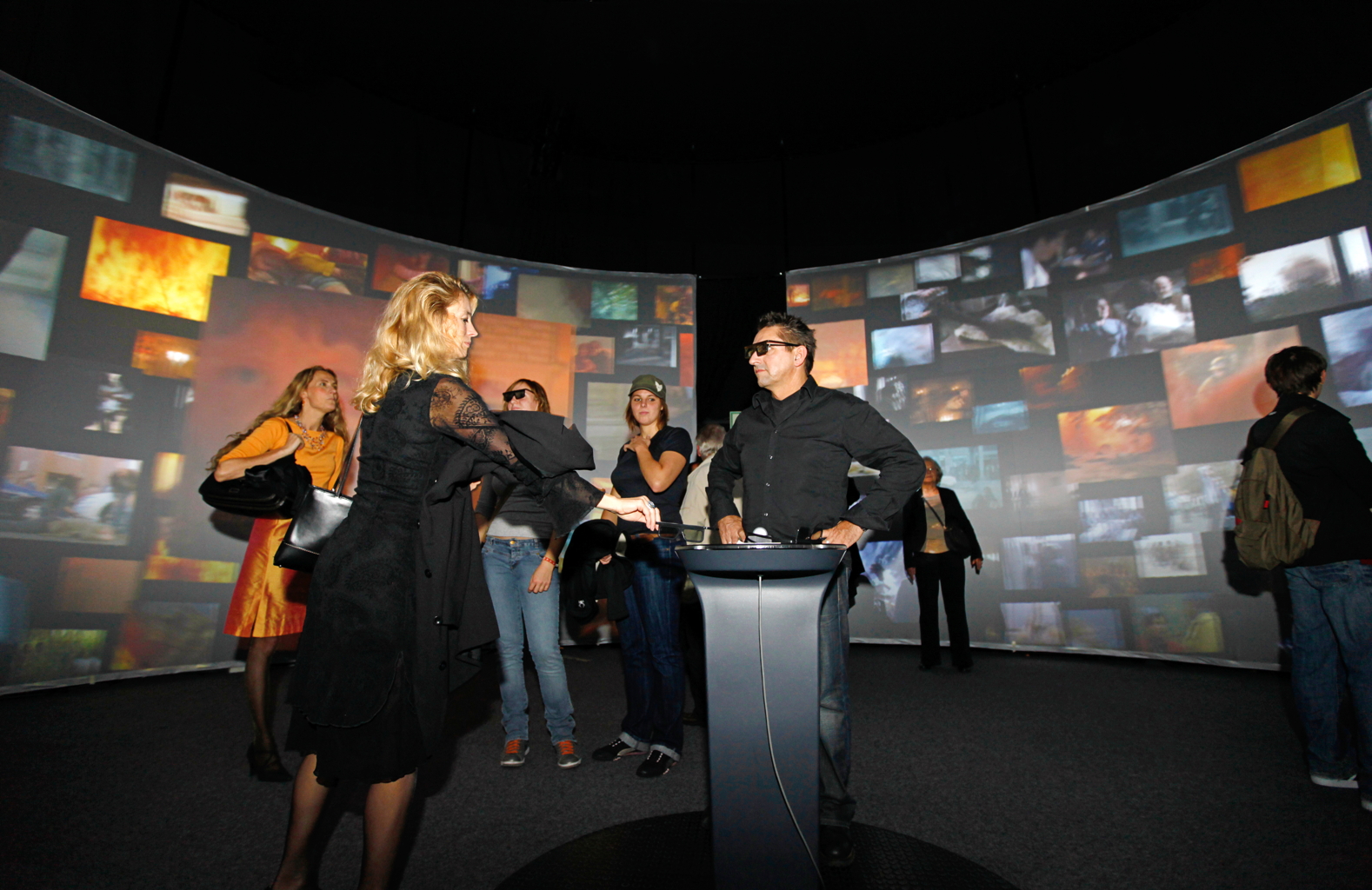 Neil Brown, Dennis Del Favero, Jeffrey Shaw, Peter Weibel, »T_Visionarium II«, 2008, Purpose-built circular theater (steel tube, truss, molleton) with entrance behind light trap, seven computers (PC) (six graphics computers, one control computer), operating system (Windows XP), custom software (based on proprietary Virtools Game Engine, licence on IG0 computer), two TFT monitors, pedestal with interface, custom-made electronics (based on Intersense InertiaCube3 inertial tracker), audio interface (RME Fireface), network switch (KVM), network switch, six projector pairs with polarizers, stereo projection screen (perforated silver screen), 24 speakers (active), two subwoofers, pedestal with polarizing glasses © Neil Brown, Dennis Del Favero, Jeffrey Shaw, Peter Weibel; Photo © ZKM | Center for Art and Media, Photo: ONUK© Neil Brown, Dennis Del Favero, Jeffrey Shaw, Peter Weibel; Photo © ZKM | Center for Art and Media, Photo: ONUK