
- Installation
Connection Machine CM-2
The Dream of an Electronic Brain
Wed, March 25 – Sun, August 02, 2026
- Location
- Foyer
- Entrance fee
- Free admission
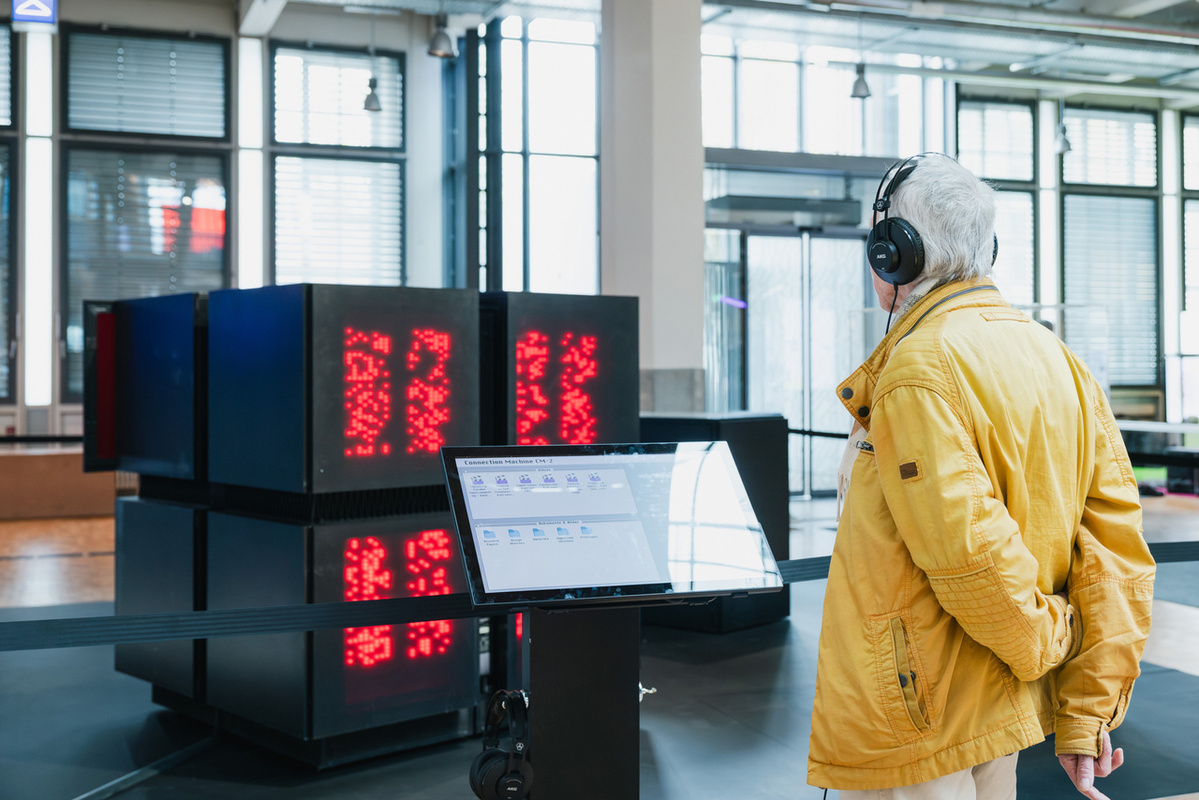
The Connection Machine CM-1 and Connection Machine CM-2 – two supercomputers developed in the 1980s by Thinking Machines Corporation – are among the most significant objects in the history of computing and design: both as a technological pioneering achievement and as an iconic design object. On the occasion of the conference Visionary AI: The Forgotten Legacy of the Connection Machine, the ZKM and KIT present a CM-2 in the foyer.
In the 1980s, a milestone was reached not only in the history of computing but also in the history of design with the creation of the Connection Machine CM-1, produced by the U.S. company Thinking Machines Corporation. W. Daniel „Danny“ Hillis was the inventor of the machine and the driving force behind the effort to develop the first commercial supercomputer specifically designed for tasks in artificial intelligence and parallel data processing. In 1987, the Connection Machine CM-2 was introduced by Thinking Machines as the successor to the CM-1 released in 1986; it incorporated dedicated hardware accelerators for scientific computing.
Unlike conventional computers, the CM-1 and CM-2 did not rely on a single, particularly powerful processor. Instead, they distributed computations across more than 64,000 small processors that operated simultaneously and in an interconnected manner – similar to the networked thinking of the human brain. This principle of “massively parallel architecture” made the machine a visionary precursor of many of today’s high-performance computers and influenced later developments in the fields of AI and supercomputing.
Yet the Connection Machine is not only technologically remarkable – it is also a unique design object. It translated a highly abstract, invisible computing architecture into a sensually perceptible, symbolically charged form. Responsible for this concept was Tamiko Thiel, who, as head of the Mechanical and Industrial Design Group at Thinking Machines, played a decisive role in shaping both the machine’s technical “shell” and its aesthetic design. Building on the 12-dimensional hypercube structure of the 4,096 chips – whose visualization was significantly influenced by collaboration with the physicist Richard Feynman – she developed the iconic “cube-of-cubes” motif: eight visually interlocked cubes that spatially express the internal logic of interconnection. The design thus did not follow a purely utilitarian interpretation of “form follows function,” but rather an expanded reading in which diagrammatic and immaterial functions are also made visible. In collaboration with the industrial designers Allen Hawthorne and Gordon Bruce, the 4,096 red status LEDs for the processor chips shine through the matte-black, monolithic case. They visualize the parallel activity of the processors, give the machine the character of a living electronic brain, and function as an aesthetic expression of its “thinking.”
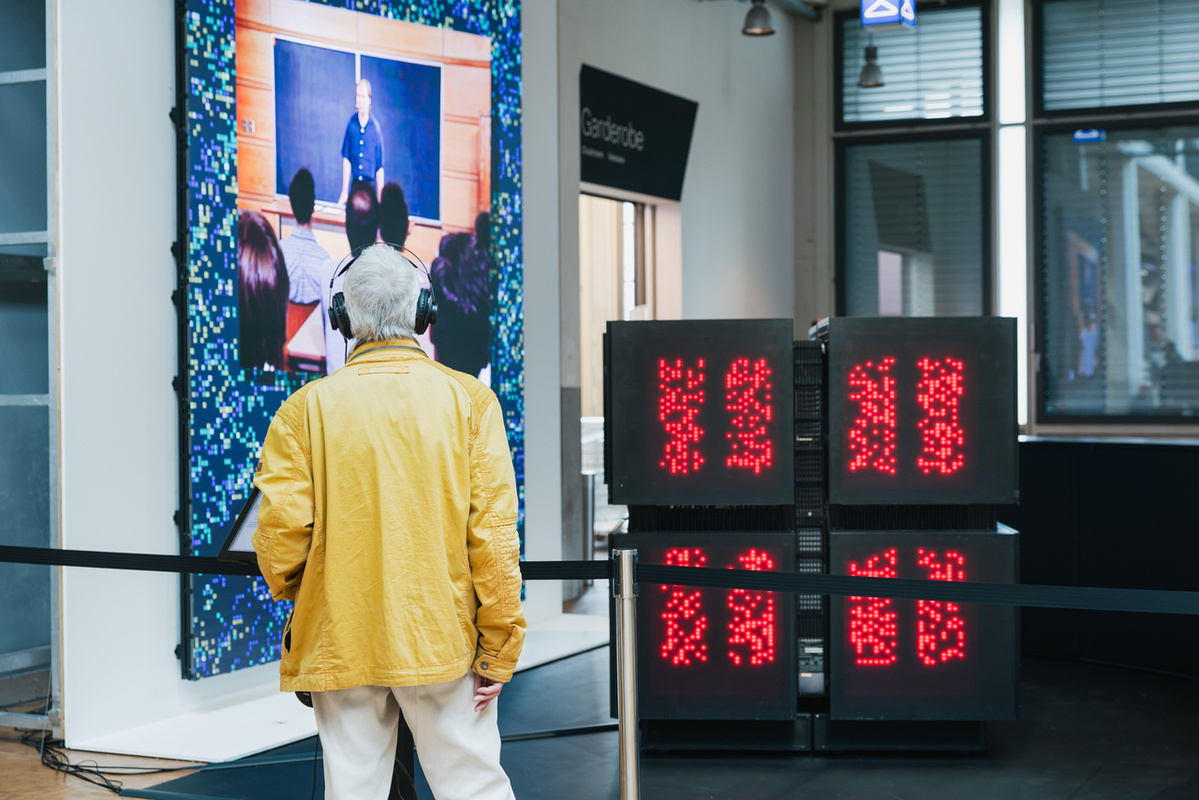
Although the Connection Machine on display is no longer operational, the activity patterns of the status LEDs have been reconstructed at KIT. At ZKM, visitors have the opportunity to modify the lights themselves: unlike in the original version, in which the light pattern was linked to the program running on the machine, both the brightness and the rhythm of the “blinking lights” can now be controlled by visitors directly via Wi-Fi.
The ZKM, in cooperation with the KIT, presents this extraordinary historical object in the museum: as testimony to an early era of AI research and as an example of how design can help make highly complex technologies understandable and experientially accessible to a broad audience. The exhibition invites reflection on the origins of modern AI and demonstrates how design and technical thinking intertwine – a perspective of great significance in our digitally networked world today.
In addition to the supercomputer itself, the exhibition features a specially commissioned essay film by Max Clausen exploring the Connection Machine. The presentation is complemented by related works, including Karl Sims' pioneering computer animations created using the Connection Machine CM-2 and CM-5.
Prof. Dr. Michael Beigl (Professor of Pervasive Computing Systems / TECO at KIT) on the visual design of the Connection Machines:
“The CM-2 has demonstrated how visual design can make internal processes visible and intelligible. Its “electronic brain”–like architecture translated abstract concepts such as massive parallelism into a tangible spatial form, shaping both scientific understanding and public perception.
Today, contemporary AI systems, especially large language models, lack similarly compelling visual representations of their internal operations. Developing such representations remains an open challenge, leaving the CM-2 as an enduring reference for how visualization can mediate between technical complexity and broader comprehension.”


Imprint
Curators: Alistair Hudson, Daria Mille
Curatorial Producer: Hanna Jurisch
Concept and implementation of the new LED panels for the CM-2: Philipp Lepold, Michael Beigl
Technical Project Management: Felix Pausch
Film: Max Clausen
LED-Wall: Daniel Heiss